How often should you sealcoat your driveway in California?
Every 3 to 5 years is the honest answer for a California driveway, and the first coat should wait 6 to 12 months after new asphalt goes down. The Asphalt Institute, the industry’s own engineering body, says a well-built driveway should not need sealing for 2 to 5 years, and sealing more often than the surface needs causes its own problems. If your sealcoating pitch says every year, you are being sold sealer, not protection.
Here is how to time it right in the North Bay, and how to tell when your driveway actually needs it.
What does sealcoating actually do?
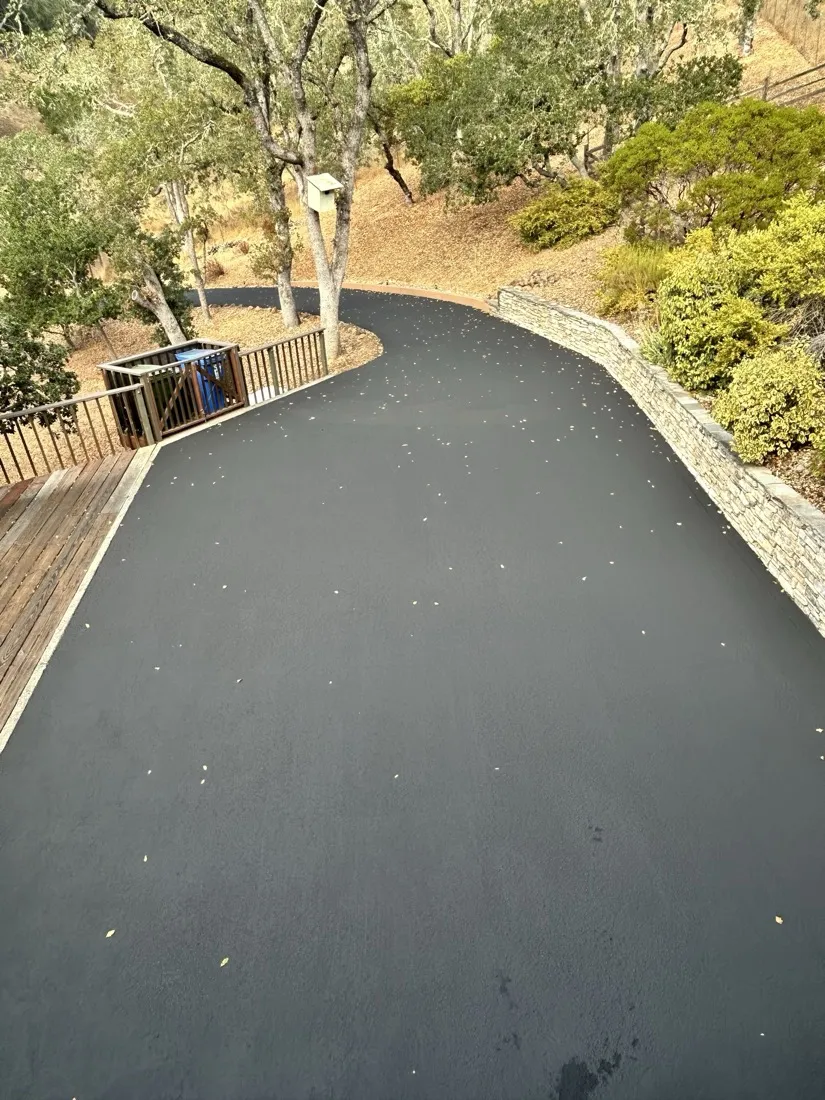
Asphalt is rock and sand held together by a petroleum binder. Sun and water slowly break that binder down: the deep black fades to gray, the surface turns brittle, hairline cracks open, and loose stones start coming free under tires. Sealcoating lays a thin protective film over the surface that takes the sun and rain instead of the binder, fills the surface pores, and restores the black finish.
Just as important is what it does not do. Sealer adds no structural strength. It will not fix alligator cracking, potholes, soft spots or drainage problems, and it will not stop raveling that has already started. Those are asphalt repair jobs, and any cracks need filling before sealer goes on, not after.
How often should you seal in California?
| Question | The short answer |
|---|---|
| First coat on new asphalt | wait 6 to 12 months after paving |
| Recoat cycle in a mild climate | every 3 to 5 years |
| The real trigger | water no longer beads on the surface |
| Weather to apply it | above 50 degrees, dry for 24 hours after |
| Best months in the North Bay | roughly May through early October |
| Back on the driveway | about 24 hours, 48 is safer |
California’s mild winters actually stretch the cycle compared to freeze and thaw states. There is no ice wedging cracks open and no road salt chewing the surface, so the main aging force here is UV. That is also why the calendar matters less than the pavement itself: seal when the black has gone gray and water soaks in instead of beading, not because a year passed.
Over-sealing is a real failure mode. Stacked coats build a brittle film that alligator-cracks and peels, which is exactly the look people seal to avoid. If a company wants to seal your driveway every season, decline politely.
When in the year should you sealcoat in Sonoma County?
Sealer wants warmth and a dry day: 50 degrees and rising, no rain for at least 24 hours, ideally 48. Petaluma’s rain calendar makes that simple. Roughly nothing falls from June through September, while November through March carries almost all of the year’s rain. December and January average highs sit in the upper 50s, right on the edge of workable.
So the practical sealing season here runs from late spring into early fall. There are two good strategies inside it. Seal in early summer and the coat cures in guaranteed dry weather. Or seal in late September into early October, so a fresh, fully cured coat meets the first storms; that one is a race against the forecast, so book it rather than gamble on it.
One more local note: the coal tar sealers that several East Coast states banned are not what we are talking about here. California never enacted its proposed ban, but asphalt-emulsion sealers are the standard product for this market and the one we recommend.
Is sealcoating worth the money?
As protection for sound pavement, yes, and the math is simple. Professional sealcoating for a typical two-car driveway runs a few hundred dollars. Structural repairs run $4 to $10 per square foot, and repaving costs thousands. Slowing the slide from “faded” to “failing” is the whole job, and a few hundred dollars every few years against a five-figure driveway is cheap insurance.
What it is not is a rescue. If the surface is alligator-cracked, rutted or coming apart, sealer is money painted over a problem. We will tell you which side of that line your driveway is on, and quote sealcoating or repair accordingly, not both by default.
Get your driveway looked at before the rains
The right plan usually takes one look: fill the cracks, patch what failed, seal what is sound, and time it before the wet season. Call (707) 217-0835 and we will look at your driveway anywhere in Petaluma, Santa Rosa or the North Bay and tell you what it needs this year and what can wait.