How much does a gravel driveway cost in Sonoma County?
Published national ranges put a gravel driveway at $1.25 to $4.00 per square foot installed, per HomeAdvisor. At a 12 foot width, that is $1,500 to $4,800 for the first 100 feet. At 1,000 feet it runs $15,000 to $48,000. Bay Area Grading and Paving reports that California driveway paving runs 15 to 25 percent above national averages. Plan on the upper half of any published range here.
Those are market figures, not a quote. Your own number depends on how deep the base goes and how far the rock travels. Winter water moves it too.
What does a gravel driveway cost per square foot and by length?
Gravel prices out far below asphalt in the published guides. HomeAdvisor lists $1.25 to $4.00 per square foot installed for gravel driveways and roads. LawnStarter publishes a tighter $1 to $3 per square foot installed, and Fixr puts the materials alone at $1 to $3 per square foot. Bob Vila puts installation at $1.25 to $1.80 per square foot.
The table below multiplies HomeAdvisor’s $1.25 to $4.00 per square foot by length at a 12 foot width. That width is the minimum traffic lane Sonoma County’s fire safe standards call for on a driveway. A quarter mile is 1,320 feet.
| Length at 12 feet wide | Square feet | Published range at $1.25 to $4.00 per sq ft |
|---|---|---|
| 100 ft | 1,200 | $1,500 to $4,800 |
| 200 ft | 2,400 | $3,000 to $9,600 |
| 500 ft | 6,000 | $7,500 to $24,000 |
| 1,000 ft | 12,000 | $15,000 to $48,000 |
| 1,320 ft (quarter mile) | 15,840 | $19,800 to $63,360 |
HomeAdvisor’s own long example lands in the same place. It prices a 530 foot private road, 16 feet wide, at $10,600 to $33,920. The table brackets the market. Your drive lands on its own spot inside it. Our page on building and regrading gravel drives covers what actually goes into the number.
What drives the price up or down?
Base depth is the biggest lever. Rock is sold by the cubic yard, so every extra inch of depth across a long drive is another truckload. North Bay Materials delivers across Sonoma County. It lists three quarter inch Class II road base starting at $88 a cubic yard. One yard covers about 65 to 80 square feet at a 4 to 6 inch compacted depth.
Material type matters too. A drive is built in layers. Compacted Class 2 aggregate base goes down first, then a crushed rock topping. Decorative stone costs more. HomeAdvisor’s material table puts river rock at $1.50 per square foot against $0.65 for base gravel.
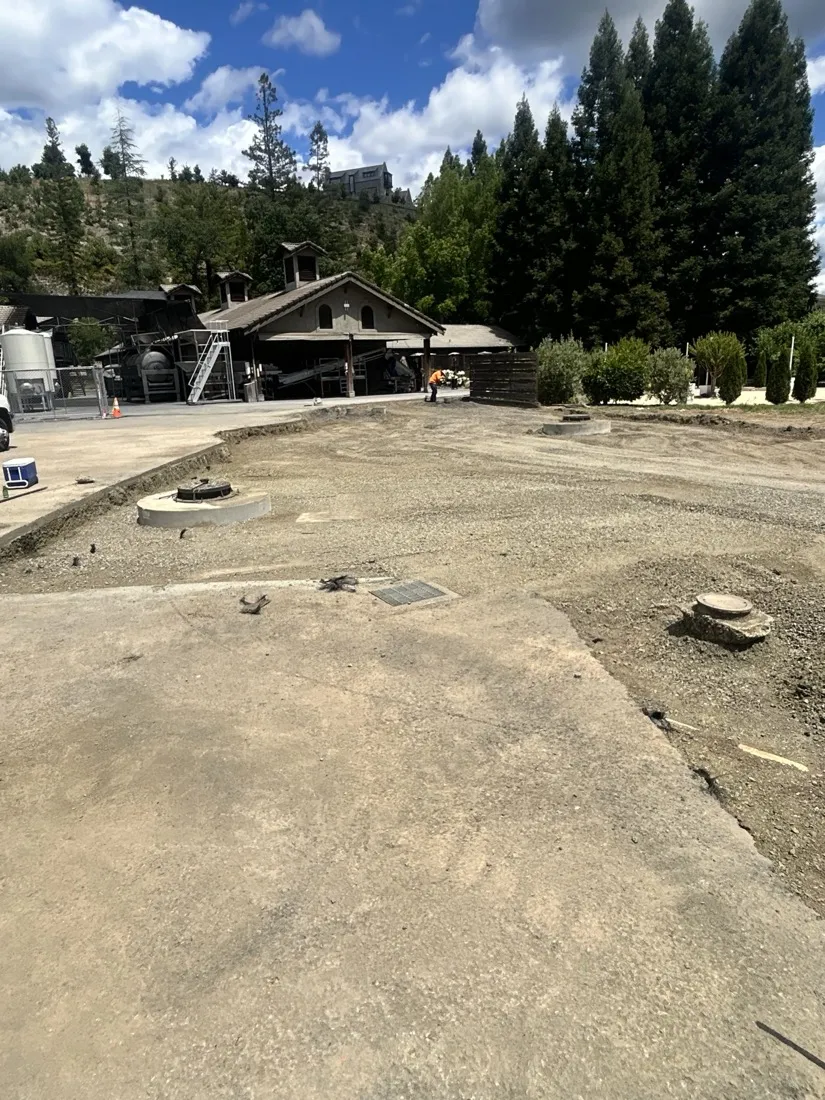
Then there is the ground itself. A flat pasture drive is cheap to shape. A hillside route needs cut and fill, and water has to be carried under the drive instead of across it. That is where culverts and roadside drainage enter the bid.
Length and width multiply everything. Going from 10 feet wide to 12 feet adds 20 percent to the square footage. Distance from the quarry adds trucking. A gate or a tight turn that keeps a loaded dump truck out adds handling.
What does Sonoma County add to the job?
Sonoma County’s fire safe standards set the shape of a rural drive before price comes up. Section 13-37 calls for a minimum 12 foot traffic lane and 15 feet of vertical clearance. Drives over 150 feet need a turnout at the midpoint. Drives over 800 feet need turnouts about every 400 feet. Each turnout runs 22 feet wide and 30 feet long with a 25 foot taper at each end. Every turnout is extra square footage of rock.
The county also sets the section under the surface. Section 13-30 requires an all-weather driving surface built to carry 75,000 pounds. On grades under 5 percent, a gravel surface is allowed. It sits over at least one foot of compacted Class 2 aggregate base. Over 10 percent, the standard calls for asphalt concrete instead, at 0.2 feet over half a foot of base. Grades in between have their own surfacing rule. A steep drive may not be able to stay gravel.
Permits are the next line. Permit Sonoma requires an encroachment permit for work in the county right of way, including a driveway entrance. Its 2026-2027 encroachment fee schedule, effective July 2026, lists $1,015 for a new driveway entrance. An existing driveway upgrade is $994. A grading permit is separate. It applies once cut or fill passes 50 cubic yards or 3 feet in depth. County Code 11.04.010.A lists the exemptions. The rules on permits for paving work go deeper.
Soil and weather finish the picture. The USDA Clear Lake clay series is mapped in Sonoma County. It cracks as deep as 48 inches when it dries. Those cracks close again in the fall. Ground that moves like that eats a thin base. Rain here is seasonal. The Western Regional Climate Center’s record for the Petaluma Airport station shows about 25 inches a year. July averages 0.02 inches. Rock goes down best in that dry stretch.
Can you start with gravel and pave it later?
Yes, and it is a common plan on rural property. A gravel drive built on a compacted base is the same base a paved drive needs. When the budget comes around, hot mix goes over it rather than starting again. The county’s own spec for steeper ground shows the idea: asphalt concrete over compacted Class 2 aggregate base.
For a drive serving one house, that later step is paving a single home driveway with hot mix. For a shared or ranch road, the step is paving a private road with asphalt. Either way, the money that goes into base rock now still counts. For the paved side of the math, see what asphalt costs per square foot here.
What does the estimate visit look at?
We measure the run and check the grade. Then we look at where water crosses the route and what is under any existing surface. We check whether a loaded dump truck can get in and turn around. We look at how the drive meets the county road. Then you get a written number.
If your drive is rutting or holding water, a regrade with fresh rock is usually the fix. Our page on gravel drive construction and topping explains how we build them. When you are ready, ask for a written estimate on your drive.